

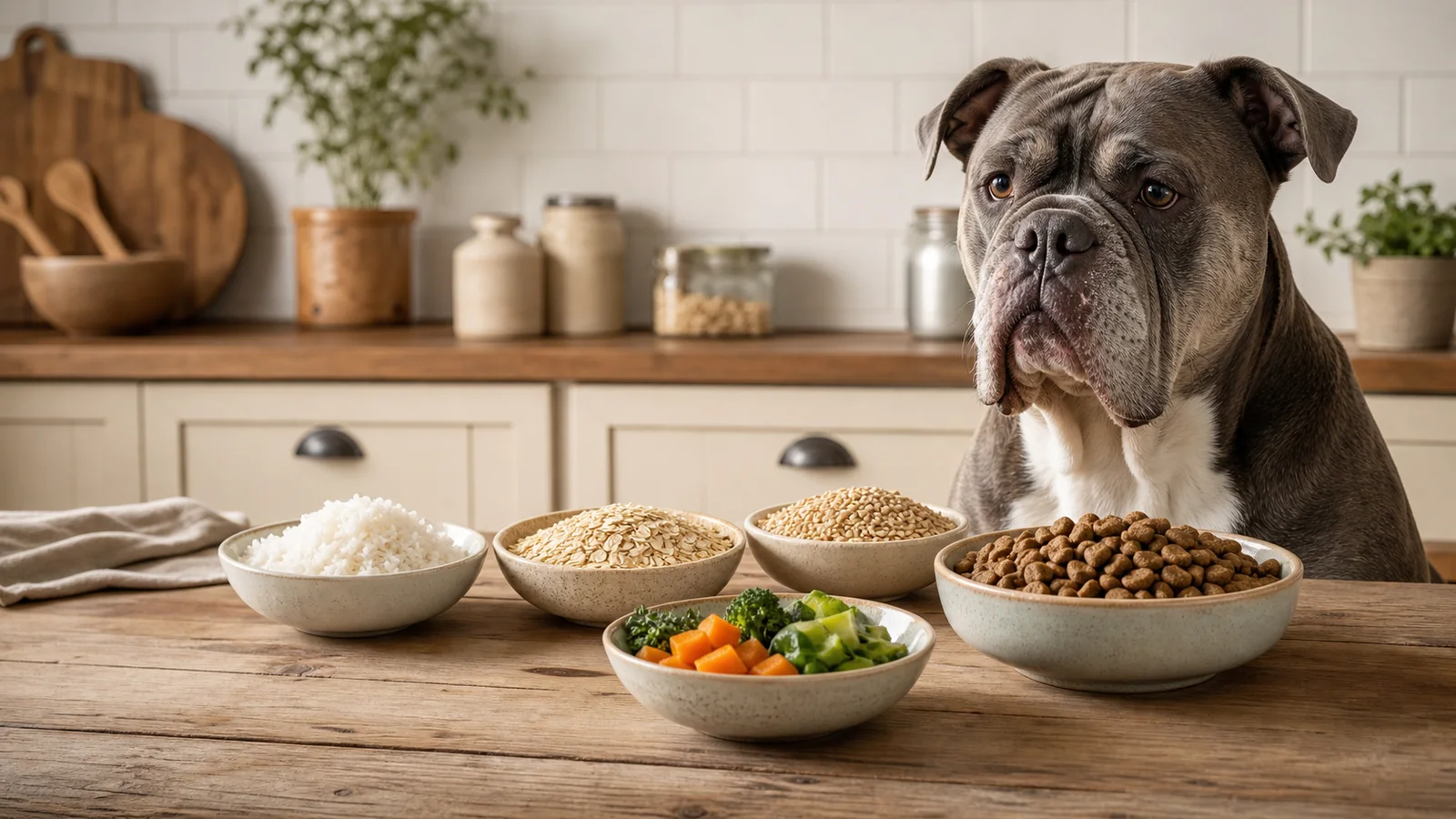
Grains in Dog Food - Healthy, Unnecessary or Even Beneficial?
Grains in dog food do not have the best reputation. Many packages now prominently display the words “grain-free,” often creating the impression that this automatically means the food is better, more natural and healthier.
But is grain in the bowl really a problem?
It is not quite that simple. Grains are not inherently bad for dogs. What matters much more is which ingredients are used overall, how the recipe is formulated and how well the carbohydrates have been processed.
Are grains in dog food bad?
Generally speaking: no.
Dogs have lived alongside humans for a very long time and have also adapted to the way we eat. Studies show that dogs can digest starch much better than wolves. Their digestive system is therefore perfectly capable of making use of carbohydrates from grains.
That does not mean, of course, that every dog tolerates every type of food equally well. But the statement that grains in dog food are fundamentally inappropriate for dogs is too simplistic.
Which grains are used in dog food?
Common examples include:
Rice
Oats
Corn
Barley
Wheat
It is not only about what is used, but also how it is processed.
Starch needs to be properly broken down so that dogs can digest it. Cooking or extrusion makes it more digestible. Rice, oats or corn can therefore be perfectly reasonable sources of energy in a well-made dog food.
Why is grain-free dog food so popular?
Many dog owners associate grain-free dog food with a particularly natural diet. This is often based on the idea that dogs are descended from wolves and should therefore eat as much meat and as little grain as possible.
At first, that sounds logical, but it is only part of the story.
Today’s domestic dog is not a wolf. Over many generations, dogs have adapted to living with humans and also to the foods humans provided. This includes the ability to digest starch.
And grain-free does not automatically mean carbohydrate-free.
If rice, oats or corn are removed from a recipe, they are usually replaced by other sources of carbohydrates. That is why it is worth looking beyond the word “grain-free” and checking the full list of ingredients instead.
What is used instead in grain-free dog food?
In many grain-free foods, grains are replaced by potatoes or legumes in dog food.
These may include:
Peas
Lentils
Chickpeas
Beans
That is not automatically a bad thing either. In recent years, however, researchers have looked more closely at whether certain grain-free recipes containing very high amounts of these ingredients could be problematic for some dogs.
Grain-free diets and heart problems in dogs
Since 2018, the U.S. Food and Drug Administration, among others, has been investigating a possible link between certain types of dog food and dilated cardiomyopathy in dogs, commonly known as DCM.
With this condition, the chambers of the heart become enlarged and the heart’s pumping ability can weaken.
What stood out was that many of the reported dogs had been fed grain-free diets containing relatively large amounts of peas, lentils, potatoes or other legumes. However, there is still no clear proof that this type of diet directly causes the disease.
And that distinction is important.
You cannot say that grain-free food causes heart disease. At the same time, you should not assume that “grain-free” automatically means a food is especially healthy.
What does BEG diet mean?
The term BEG diet often appears in this context.
BEG stands for:
Boutique
Exotic Ingredients
Grain-Free
The term refers to foods from smaller brands that often use less common protein sources such as venison, bison or duck, avoid grains and instead contain larger amounts of legumes.
The term itself already shows what the discussion is really about.
Not grain alone.
But the complete formulation of the food.
Is grain-free dog food worse?
No. That would be too simple as well.
A grain-free dog food can be very well formulated. At the same time, a food that contains grains can be poorly made. The large claim on the front of the package often tells you less about quality than you might think.
More useful questions are:
Which ingredients appear at the top of the ingredient list? How high is the proportion of legumes? Which protein sources are being used? Is the product formulated as a complete and balanced food?
A long-term study comparing different carbohydrate sources found no clinically relevant changes in the heart markers examined in healthy adult dogs over 18 months. This also shows that the issue is more complex than simply “grain is good” and “grain-free is bad.”
When can grains still cause problems?
Of course, some dogs do not tolerate certain ingredients in their food.
If your dog regularly suffers from diarrhoea, bloating, itching or other symptoms, grain may quickly become the main suspect. But that does not necessarily mean it is the cause. Animal proteins and other ingredients can also trigger intolerances.
Instead of removing more and more ingredients on suspicion alone, persistent problems are better investigated together with a veterinarian to identify the actual cause.
Grains in dog food and heart risks
For dog breeds with a known predisposition to heart disease, it is worth paying particularly close attention to nutrition.
In Dobermans and some other breeds, genetics play an important role in DCM. Boxers, meanwhile, can be affected by another genetically influenced form of cardiomyopathy. Especially in such dogs, a balanced and well-researched diet is particularly important.
Conclusion: Grains in dog food are not a sign of quality
Grains in dog food are neither automatically bad nor automatically good.
When properly processed, rice, oats, corn and other grains can be easily digestible sources of carbohydrates for dogs. At the same time, the term “grain-free” alone says very little about how good a food really is.
What matters is the overall picture.
A good dog food should be balanced, provide all essential nutrients and suit the dog’s age, activity level and health status.
That is why taking a closer look at the ingredient list is usually more useful than relying on bold marketing claims.
Because in the end, it does not matter whether the package says “with grains” or “grain-free.”
What matters is what actually ends up in the bowl.