

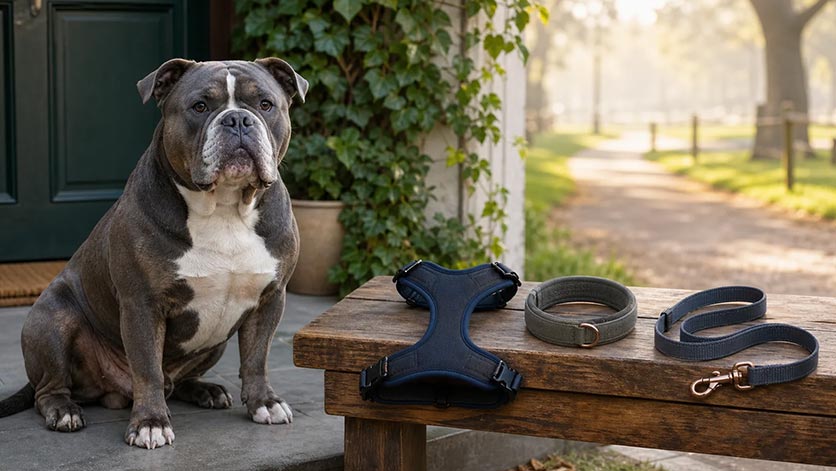
When we go for a walk with our dogs, we usually focus on a lot of things: Is the dog relaxed? Is he pulling on the leash? Are other dogs approaching? What we think about far less often is what leash, collar and harness actually do to a dog’s body.
As soon as there is tension on the leash, forces are created. With a collar, they act on the neck. With a harness, they are distributed more across the chest and shoulder area. At first glance, that makes the answer seem obvious: harness good, collar bad. But it is not quite that simple.
What happens when a dog pulls on a collar?
A collar sits around a sensitive part of the body. The larynx, trachea and various soft tissues are all located in this area. If a dog pulls hard forward, the pressure is concentrated on a relatively small surface.
Studies suggest that pulling on a dog collar can even increase intraocular pressure. In comparable studies, this effect was not observed in the same way when a harness was used.
That does not mean every collar is automatically problematic. A dog walking calmly beside you with very little tension on the leash places very different strain on the neck than a dog that spends the entire walk pulling forward with full force.
Why doesn’t a dog simply stop pulling?
Anyone who has walked an excited dog knows the situation. Another dog is up ahead, there is an irresistible smell somewhere, or a cat disappears behind a hedge. Suddenly, the dog is leaning into the leash.
You might expect the pressure on the neck to become uncomfortable enough to make the dog stop. In practice, that often does not happen. If the motivation is strong enough, many dogs simply keep pulling.
A collar is therefore not a particularly good tool for mechanically controlling a dog that pulls constantly.
Is a harness automatically better?
For the neck, a well-fitting dog harness is often the more comfortable option. The force is spread across a larger area instead of being concentrated directly around the neck.
But the pressure does not disappear.
It simply moves elsewhere.
With a harness, the chest, shoulder area and front limbs are affected instead. And this is where a poorly fitting harness can also cause problems. If a strap sits in the wrong position or runs directly across the shoulder, it can restrict the dog’s natural movement.
A Y-shaped harness is not automatically perfect
A Y-shaped harness is often considered especially ergonomic by dog owners. And this type of design can certainly work very well. But the name alone does not tell you whether the harness actually fits properly.
Changes in shoulder movement have also been measured with harnesses that are marketed as particularly movement-friendly. What matters is not what the label says, but how the harness sits on the individual dog.
The chest strap should run centrally, there should be enough space around the armpits, and the shoulders should be able to move freely when the dog walks. If a strap rubs, presses into the armpit or the harness keeps slipping to one side, either the size or the model is not suitable.
Front-clip harnesses: useful for training
With a front-clip harness, the leash is attached to the front of the chest. If the dog pulls forward strongly, the body is gently turned to the side. This can be helpful during leash training, especially with large or powerful dogs.
However, it is worth distinguishing between training and everyday use.
The sideways pull affects the movement of the front limbs. Studies comparing different harness designs suggest that front-clip models can restrict shoulder and elbow movement more than other types.
For targeted training sessions, such a harness can therefore be useful. For long daily walks, I would generally prefer a well-fitting model with the leash attached on the back.
Which harness is right for my dog?
Unfortunately, there is no single answer that works for every dog.
A Dachshund is built very differently from a German Shepherd. An Old English Bulldog has a different chest and shoulder structure from a Greyhound. Weight, muscle mass and coat also affect how a harness fits.
That means a harness that fits one dog perfectly may be completely unsuitable for another.
How to recognise a well-fitting dog harness
Do not judge a harness only while your dog is standing still. Let your dog walk a few steps and watch from the front and from the side.
Can the front legs move freely forward? Does the harness stay in place? Does anything rub under the armpits? Is a strap pressing directly across the shoulder?
You can also gently lift one front leg. This often makes it easy to notice whether the harness is restricting movement.
With very muscular, short-legged or flat-faced dogs, it is worth paying particularly close attention to fit. If your dog already has joint or musculoskeletal problems, advice from a veterinarian or canine physiotherapist can also be useful.
Collar or harness: what makes more sense for everyday use?
For many dogs, a combination works well.
The collar can carry the ID tag, address information or perhaps a GPS tracker. For walks, the leash can be attached to a properly fitted harness.
If your dog pulls strongly all the time, however, it is worth looking beyond the equipment itself. Even a perfectly fitted harness is not a long-term solution if the dog is constantly leaning into it with full force.
A good harness can distribute pressure more effectively.
But it cannot replace proper leash training.
Fit changes over time
A harness that fits perfectly today may not fit the same way two years from now.
Young dogs grow. Adult dogs gain or lose weight. Muscle mass can change with age. The harness itself may also stretch or become misshapen over time.
That is why it is worth checking the fit regularly rather than waiting until you notice rubbed fur or pressure marks.
Conclusion: The pressure does not disappear just because your dog wears a harness
When it comes to leash, collar, harness — the underestimated pressure on the chest, the point is not to condemn collars completely or declare one harness design perfect for every dog.
A dog that pulls hard against a collar can place considerable strain on the neck. At the same time, a poorly fitting harness can interfere with the movement of the shoulders and front limbs.
That is why fit, body shape and the way your dog behaves on the leash matter more than labels such as “ergonomic,” “Y-shaped” or “joint-friendly.”
And there is one point that often gets lost in all the discussion about equipment:
The best collar or harness is still the one your dog has to pull against as little as possible.